Commvault EU Alternative 2026: CLOUD Act Risk, GDPR Compliance, and Bareos vs Proxmox
Post #1158 in the sota.io EU Cloud Sovereignty Series — EU Backup & Recovery Series #3/5
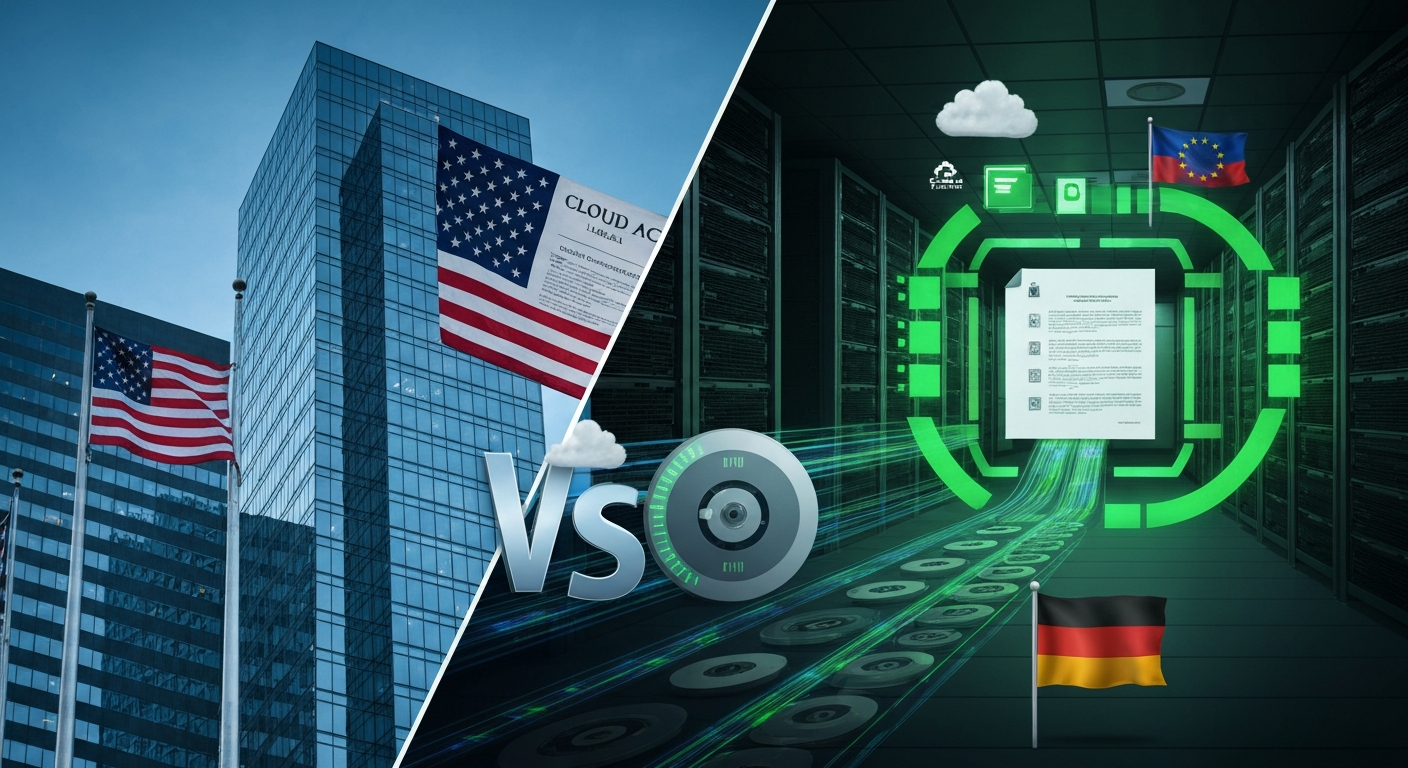
Enterprise backup data is not just a copy of your files. It is a complete, queryable snapshot of your organisation's intellectual property, customer records, financial data, and operational secrets. For EU organisations operating under GDPR, the question of who can access backup data — and under what legal compulsion — is a data protection matter of the highest order.
Commvault is one of the world's leading enterprise data protection platforms, covering backup, recovery, cloud data management, and the SaaS-delivered Metallic product line. With a 25-year history, NASDAQ listing, and customers across financial services, healthcare, and government sectors, Commvault sits at the centre of enterprise data protection stacks globally.
Unlike Veeam (Swiss parent, Series #1) or Acronis (Swiss HQ with US subsidiaries, Series #2), Commvault is an unambiguously US entity. Commvault Systems Inc. is incorporated under New Jersey law, headquartered in Tinton Falls NJ, listed on NASDAQ (CVLT), and has no non-US parent company. This corporate simplicity translates directly into elevated CLOUD Act exposure: there is no corporate layer between EU customer data and US jurisdiction.
This post scores Commvault on our 25-point CLOUD Act methodology, maps the five specific GDPR Article 44 risks arising from the Metallic SaaS platform and Commvault's cloud-connected architecture, and presents EU-native alternatives — Bareos (Germany), Proxmox Backup Server (Austria), Restic with Hetzner, and Bacula Enterprise (Switzerland) — that achieve 0–2/25 CLOUD Act scores.
Commvault Systems: Corporate Structure and US Exposure
Commvault Systems Inc. has a straightforward corporate structure: there is no Swiss parent, no EU holding company, and no PE intermediary shielding the company from US jurisdiction. What you see is what you get — a US public company subject to US law.
Corporate Jurisdiction: Commvault Systems Inc. was incorporated in New Jersey in 1996 and has been headquartered in Tinton Falls, NJ for its entire operational history. The company listed on NASDAQ in 2006 (CVLT). All board members and executive officers are US-based. The company's primary legal domicile, operational headquarters, and stock exchange listing are all within US jurisdiction.
The Metallic SaaS Acquisition: In 2019, Commvault launched Metallic as a wholly owned SaaS backup subsidiary, later absorbed fully into the Commvault product portfolio by 2022. Metallic delivers backup-as-a-service for Microsoft 365, Google Workspace, Salesforce, Azure, AWS, and on-premises workloads. Metallic's SaaS infrastructure runs on Microsoft Azure — with data landing in the region closest to the customer, but with control-plane and management operations routing through US-controlled infrastructure.
For EU organisations, Metallic raises specific GDPR Article 44 concerns because the SaaS layer — including tenant management, backup scheduling, policy enforcement, and reporting dashboards — operates through Commvault's US-controlled cloud infrastructure even when backup data nominally resides in an EU Azure region.
Investor Structure: As a NASDAQ-listed company, Commvault's largest shareholders are US institutional investors. Top holders include Vanguard Group (~8.7%), BlackRock (~7.4%), and other major US asset managers. While institutional ownership of a public company does not create the same CLOUD Act exposure pathways as PE ownership with management rights, the full US institutional structure leaves no EU ownership layer to point to in a data protection argument.
Government Sector Contracts: Commvault has documented contracts with US federal agencies including the Department of Defense and multiple federal civilian agencies. These contracts require FedRAMP authorisation (achieved) and create ongoing relationships with US intelligence-adjacent procurement systems. The company also participates in CISA's Joint Cyber Defense Collaborative (JCDC), the DHS cybersecurity information-sharing programme, which involves data exchange about threat intelligence derived from customer environments.
CLOUD Act Exposure Score: 17/25
| Dimension | Score | Rationale |
|---|---|---|
| Corporate jurisdiction | 4/5 | Pure US entity — NJ incorporation, NASDAQ-listed, no non-US parent |
| Data flows to US infrastructure | 3/5 | Metallic SaaS control plane, Commvault Cloud management, support portal |
| Parent company / institutional exposure | 3/5 | NASDAQ public company, top holders Vanguard/BlackRock (US) |
| CLOUD Act direct exposure | 5/5 | 100% US entity, directly subject — no corporate layer to mitigate |
| Intelligence community links | 2/5 | FedRAMP certified, CISA JCDC participant, DoD contracts |
| Total | 17/25 | High — pure US entity with Metallic SaaS cloud exposure |
Score context: 0–5 = minimal, 6–10 = low, 11–15 = moderate, 16–20 = high, 21–25 = critical.
At 17/25, Commvault scores higher than Veeam (15/25) and Acronis (14/25) in this series. The absence of any non-US corporate structure means there is no jurisdictional ambiguity — Commvault is definitively subject to CLOUD Act warrants for any data it holds or controls, including configuration data and backup metadata from EU customer environments.
Five GDPR Article 44 Transfer Risks
Risk 1: Metallic SaaS Control Plane
Metallic — Commvault's SaaS backup offering — is the most significant GDPR Article 44 risk vector. While Metallic backup data can be directed to EU Azure regions (e.g., West Europe / North Europe), the Metallic control plane — which includes tenant management, backup job scheduling, policy configuration, recovery orchestration, and reporting — is operated by Commvault Systems Inc. (US entity) and routes through Commvault's US-controlled SaaS infrastructure.
Impact: Backup metadata flowing to the Metallic control plane includes: job schedules and completion status, backup inventory manifests, client hostname lists, storage consumption metrics, recovery point objects, and retention policy configurations. Under GDPR's broad definition of personal data, many of these metadata elements constitute personal data (e.g., hostnames linked to specific employees' workstations, recovery points linked to specific users' Microsoft 365 accounts).
The Metallic SaaS architecture means that even an EU organisation storing backup data exclusively in Frankfurt (Azure West Europe) has its backup management and control data transiting Commvault's US-controlled infrastructure for every backup job, every policy update, and every recovery operation.
Mitigation available: Metallic is SaaS-only — there is no on-premises deployment option for the Metallic control plane. EU organisations requiring Metallic for M365/SaaS backup must accept the control plane transfer risk or switch to a Commvault on-premises deployment (Commvault Command Center) with no Metallic connectivity. On-premises Command Center avoids the Metallic control plane risk but loses the SaaS backup capabilities.
Risk 2: Commvault Command Center Cloud-Assisted Features
Commvault Command Center, the on-premises management interface, offers multiple cloud-connected features including: Commvault Cloud Management (centralised multi-site management), Commvault Orchestrate (disaster recovery orchestration), and Commvault ThreatWise (ransomware detection with cloud-assisted threat intelligence). When any of these cloud features are enabled, data flows from the on-premises Command Center to Commvault's US-hosted cloud services.
Impact: ThreatWise is particularly notable: it analyses backup data patterns for ransomware indicators and can send file metadata, hash values, and anomaly reports to Commvault's cloud threat intelligence infrastructure. For EU organisations in healthcare or finance, this creates a potential Art.44 transfer of pseudonymised data to a US entity.
Mitigation available: All cloud-connected Command Center features can be individually disabled. EU organisations should operate Command Center with cloud connectivity set to "disabled" and rely exclusively on on-premises ThreatWise processing. This requires explicit configuration and documentation for DPA compliance purposes.
Risk 3: Customer Portal and Licence Management
Commvault's customer portal (mycommvault.com) serves as the primary interface for licence management, software downloads, support tickets, and subscription billing. The portal is operated by Commvault Systems Inc. (US) and hosted on US-based infrastructure (Salesforce, US region; AWS US-East).
Impact: Licence management telemetry from Commvault deployments includes: deployment topology information (server counts, workload types, protected data volumes), hardware fingerprints for licence enforcement, and activation records linking specific EU entities to their Commvault deployments. This telemetry flows continuously to US-hosted infrastructure as long as Commvault installations are internet-connected and using standard online licence activation.
Mitigation available: Commvault supports air-gapped licence activation for regulated environments. EU organisations with strict data protection requirements should use offline activation and minimise customer portal access to avoid continuous telemetry flows.
Risk 4: Commvault AI-Powered Recovery and Arlie
Commvault has introduced Arlie, an AI-powered virtual assistant for data protection operations, integrated across Command Center and Metallic interfaces. When EU organisations interact with Arlie for recovery queries, backup troubleshooting, or capacity planning, natural language query data flows to Commvault's AI infrastructure — which includes integrations with external LLM providers.
Impact: Recovery queries directed to Arlie may contain environment-specific context including client names, backup job details, and error conditions. If Arlie routes these queries through external AI services (OpenAI, Microsoft Azure OpenAI) as part of Commvault's cloud AI infrastructure, this creates an additional Art.44 transfer chain from the EU organisation to the AI provider's US infrastructure.
Mitigation available: Arlie can be disabled in Command Center deployments. EU organisations should document the disabling of Arlie in their Records of Processing Activities (ROPA) and ensure DPA review of any planned AI-assisted recovery feature adoption.
Risk 5: CISA JCDC Threat Intelligence Sharing
Commvault's participation in the Cybersecurity and Infrastructure Security Agency's Joint Cyber Defense Collaborative (JCDC) creates a formal channel for sharing threat intelligence derived from customer environments with US government cybersecurity agencies. JCDC participants contribute threat data, attack indicators, and infrastructure information to help CISA coordinate national cyber defence.
Impact: Threat intelligence contributions from Commvault's customer base may include indicators derived from analysing backup data anomalies, ransomware incident data, and infrastructure patterns observed across Commvault's customer environments. While JCDC contributions are supposed to be aggregated and anonymised, the programme creates a formal legal pathway for information originating from EU customer environments to reach US government cybersecurity agencies.
Mitigation available: This risk cannot be mitigated through Commvault configuration. EU organisations concerned about JCDC-related data flows should formally assess this risk and document it in their DPA, noting that the risk arises from Commvault's relationship with CISA rather than from direct EU-to-US data flows.
EU-Native Backup Alternatives
Bareos — 0/25 CLOUD Act Score
Corporate entity: Bareos GmbH & Co. KG, Cologne, Germany (EU-incorporated, no US parent, German limited partnership)
Bareos (Backup Archiving REcovery Open Sourced) is an enterprise-grade fork of Bacula, actively developed in Cologne since 2010. It is distributed under GPL-2.0, with the company offering commercial enterprise subscriptions that include support contracts, high-availability modules, and additional storage backends.
Feature comparison vs Commvault:
| Feature | Commvault | Bareos |
|---|---|---|
| CLOUD Act score | 17/25 | 0/25 |
| VM backup (VMware/Hyper-V) | ✅ Full support | ✅ Via plugins |
| Physical server backup | ✅ Full agent support | ✅ Linux + Windows agents |
| Kubernetes backup | ✅ Native + Metallic | ❌ Not native |
| M365 SaaS backup | ✅ Metallic | ❌ Not supported |
| Deduplication | ✅ Global inline | ✅ Plugin-based |
| Encryption | ✅ AES-256 | ✅ AES-256 |
| Web UI | ✅ Command Center | ✅ WebUI (included) |
| Commercial support | ✅ Vendor support | ✅ Bareos GmbH subscription |
| BSI C5 audit | ❌ No BSI | ✅ BSI audit-friendly architecture |
Licensing: Bareos Community Edition is free under GPL-2.0. Bareos Subscription includes enterprise plugins (NDMP, VMware, dedup), priority support, and SLA guarantees from the German team.
Target use case: Bareos is strongest for traditional workloads — physical servers, Linux/Windows VMs, database backups via plugins. It is not a match for organisations primarily backing up SaaS data (M365, Salesforce) or requiring Kubernetes-native backup.
Migration path from Commvault:
- Deploy Bareos Director + Storage Daemon on EU-hosted infrastructure (Hetzner CCX13, €26/mo per node)
- Install Bareos File Daemon on protected clients
- Configure backup pools and retention policies
- Establish S3-compatible offsite backup target (Hetzner Object Storage €5/TB)
- Decommission Commvault agents and Command Center after parallel validation (4–6 weeks)
Estimated migration cost: €0 software + €50–200/mo infrastructure (Hetzner) for a 50-server environment. Bareos Subscription: €2,000–8,000/year depending on tier.
Proxmox Backup Server — 0/25 CLOUD Act Score
Corporate entity: Proxmox Server Solutions GmbH, Vienna, Austria (EU-incorporated, no US parent or PE backing)
Proxmox Backup Server (PBS) is designed specifically for backing up Proxmox VE hypervisor environments, QEMU/KVM VMs, and LXC containers. It features client-side deduplication, client-side encryption, and a pull-based architecture that eliminates the need for backup agents on protected VMs.
Strengths for EU organisations:
- Zero SaaS dependencies — entirely self-hosted, no cloud control plane
- Client-side encryption with user-managed keys (backup server cannot decrypt data)
- Client-side deduplication reduces network bandwidth and storage costs
- REST API for automation and integration with existing tools
- Native Proxmox VE integration (included in enterprise subscription)
Limitations compared to Commvault:
- Optimised for Proxmox VE environments — limited support for VMware, Hyper-V
- No native M365 or SaaS backup
- No tape library support
- Smaller ecosystem compared to Commvault's 25-year tooling library
Best for: EU organisations running Proxmox VE infrastructure (increasingly common in public sector and SME after VMware licensing changes) seeking a zero-dependency, EU-sovereign backup solution.
Restic + Hetzner Object Storage — 0/25 CLOUD Act Score
Corporate entity: Restic is an open-source project with no corporate entity. Hetzner Online GmbH is incorporated in Gunzenhausen, Bavaria, Germany.
Restic is a modern backup program written in Go, designed around immutability, deduplication, and strong encryption. Combined with Hetzner Object Storage (€0.0044/GB-month, S3-compatible), it provides a fully EU-sovereign backup target.
Infrastructure cost comparison (10TB backup storage):
| Solution | Monthly Cost | CLOUD Act | Jurisdiction |
|---|---|---|---|
| Commvault Metallic | €1,200–2,500 | 17/25 | US (NJ) |
| Bareos + Hetzner | €5–50 + infra | 0/25 | DE + Germany |
| Restic + Hetzner | €44 (10TB S3) | 0/25 | DE + Germany |
| Proxmox Backup Server | €26 infra + PBS | 0/25 | AT + Germany |
| Bacula Enterprise | €2,000–5,000/yr | 2/25 | Switzerland |
Restic setup for EU organisations:
# Install restic
apt install restic

# Initialise Hetzner Object Storage backend
export AWS_ACCESS_KEY_ID="hetzner-key"
export AWS_SECRET_ACCESS_KEY="hetzner-secret"
restic -r s3:https://nbg1.your-objectstorage.com/mybucket init

# Daily backup of /data with encryption
restic -r s3:https://nbg1.your-objectstorage.com/mybucket \
  backup /data --verbose

# Verify backup integrity
restic -r s3:https://nbg1.your-objectstorage.com/mybucket check
For VM-level backups: Combine Restic with libvirt snapshots (KVM) or Proxmox VE snapshot APIs to achieve consistent VM backup without Commvault agents.
Bacula Enterprise — 2/25 CLOUD Act Score
Corporate entity: Bacula Systems SA, Pont-la-Ville, Switzerland (EU-adjacent, no US parent)
Bacula Enterprise is the commercial offering from Bacula Systems, a Swiss company building on the open-source Bacula project. It supports enterprise workloads including VMware, Hyper-V, Oracle, SAP HANA, and tape libraries.
Why 2/25 (not 0/25): Switzerland is not an EU member state but benefits from GDPR adequacy status. Bacula Systems has no US parent, no US PE ownership, but international data transfers to/from Switzerland are subject to standard GDPR adequacy mechanisms (not CLOUD Act exposure). Score reflects the small adequacy delta between Switzerland and EU incorporation.
Strengths: Enterprise support SLAs, tape integration, broad platform support, proven in large data centre deployments, NDMP for NAS backups.
GDPR Compliance Decision Framework
For EU organisations evaluating Commvault alternatives, the decision typically follows three key questions:
Question 1: What workloads are you backing up?
- Physical servers + Linux/Windows VMs → Bareos or Bacula Enterprise
- Proxmox VE VMs → Proxmox Backup Server
- Small/medium file backup → Restic + Hetzner
- M365/SaaS data → Consider Veeam Backup for M365 with EU data processing agreement, or migrate to EU-native SaaS providers
Question 2: What is your team's operational maturity?
- High maturity, self-manage infrastructure → Restic or Bareos Community
- Medium maturity, want support contracts → Bareos Subscription or Bacula Enterprise
- Low maturity, prefer managed service → Hetzner Storage Box + managed backup provider
Question 3: What is your regulatory context?
- GDPR only → Any EU-native solution at 0–2/25
- NIS2 + GDPR → Bareos (DE) or Bacula Enterprise with formal DPA agreements
- BSI IT-Grundschutz → Bareos (BSI-auditable architecture) or custom Restic/BorgBackup
- Healthcare (DSGVO-kritisch) → Bareos + Hetzner with documented data processing agreement
12-Week Migration Plan: Commvault to EU-Native Backup
Weeks 1–2: Assessment
- Inventory all Commvault-protected workloads (VMs, physical, SaaS)
- Identify Metallic SaaS dependencies vs on-premises Command Center usage
- Document current RTO/RPO requirements per workload tier
- Assess Arlie and cloud-connected feature usage
Weeks 3–4: EU-Native Infrastructure Setup
- Deploy Bareos Director + Storage Daemon on Hetzner dedicated server (AX41, €34/mo)
- Configure Hetzner Object Storage as offsite backup target (€0.0044/GB-mo)
- Establish encryption key management (Vault or SOPS in EU-hosted KMS)
- Test backup/restore cycle with non-production workloads
Weeks 5–8: Parallel Operation
- Deploy Bareos File Daemon on all protected clients alongside Commvault agents
- Run parallel backup jobs — validate restore from both systems
- Document any workload types requiring fallback (VMware VMs, M365)
- Adjust retention policies and backup windows in Bareos configuration
Weeks 9–10: Workload Migration
- Cut over production workloads tier by tier (low priority first)
- Deactivate Metallic SaaS tenants after successful Bareos validation
- Retain Commvault licences through contract end (do not cancel prematurely)
- Update DPA, ROPA entries to reflect new backup processor (Bareos GmbH DE)
Weeks 11–12: Decommission and Compliance Documentation
- Remove Commvault agents from all migrated clients
- Delete Metallic tenant data (document deletion per GDPR Art.5(1)(e))
- Archive Command Center configuration for 3-year audit retention
- Update privacy policy and data processing agreements with EU backup providers
- Generate compliance report for DPO: Data flow map showing 0/25 CLOUD Act exposure
Commvault vs EU Alternatives: Summary Scorecard
| Vendor | CLOUD Act | GDPR Art.44 | HQ | M365 Backup | VM Backup | Cost/TB/mo |
|---|---|---|---|---|---|---|
| Commvault (Metallic) | 17/25 | Risk: Control plane | US (NJ) | ✅ Native | ✅ All | €120–250 |
| Bareos Enterprise | 0/25 | ✅ Minimal | DE (Cologne) | ❌ | ✅ Via plugins | €5–50 |
| Proxmox Backup Server | 0/25 | ✅ Minimal | AT (Vienna) | ❌ | ✅ Proxmox native | €2–10 |
| Restic + Hetzner | 0/25 | ✅ Minimal | DE (Gunzenhausen) | ❌ | ✅ Via snapshot | €4–5 |
| Bacula Enterprise | 2/25 | ✅ SCCs adequate | CH | ❌ | ✅ Full | €200–500 |
| Veeam (Series #1) | 15/25 | Risk: Support/Kasten | CH + US | ✅ | ✅ All | €80–200 |
| Acronis (Series #2) | 14/25 | Risk: SCS LLC | CH + US | ✅ | ✅ All | €60–180 |
Key Takeaway for EU Organisations
Commvault is a capable enterprise backup platform with a 25-year track record. For EU organisations without GDPR data sovereignty requirements, its coverage of SaaS backup (Metallic for M365, Salesforce, Google Workspace) makes it operationally compelling.
For EU organisations with GDPR compliance requirements — particularly those in healthcare, finance, or public sector — Commvault's 17/25 CLOUD Act score and Metallic's US-controlled SaaS control plane create meaningful Art.44 transfer risks that require formal DPA assessment, SCC implementation, and ROPA documentation.
The most effective mitigation is architectural: replacing Metallic with EU-native backup tools and operating Commvault Command Center in fully air-gapped mode. The most complete mitigation is vendor replacement: Bareos (Germany), Proxmox Backup Server (Austria), or Bacula Enterprise (Switzerland) each achieve 0–2/25 CLOUD Act scores and provide a clear, documentable path to GDPR-compliant backup without US jurisdiction exposure.
Next in the EU Backup & Recovery Series: Rubrik EU Alternative 2026 — Palo Alto CA, Sequoia/Microsoft-backed, CLOUD Act exposure for cloud-delivered data protection with EU-only alternatives.
This analysis is based on publicly available information about corporate structures, product architectures, and legal frameworks as of May 2026. It does not constitute legal advice. EU organisations should consult qualified legal counsel for GDPR compliance assessments.
EU-Native Hosting
Ready to move to EU-sovereign infrastructure?
sota.io is a German-hosted PaaS — no CLOUD Act exposure, no US jurisdiction, full GDPR compliance by design. Deploy your first app in minutes.